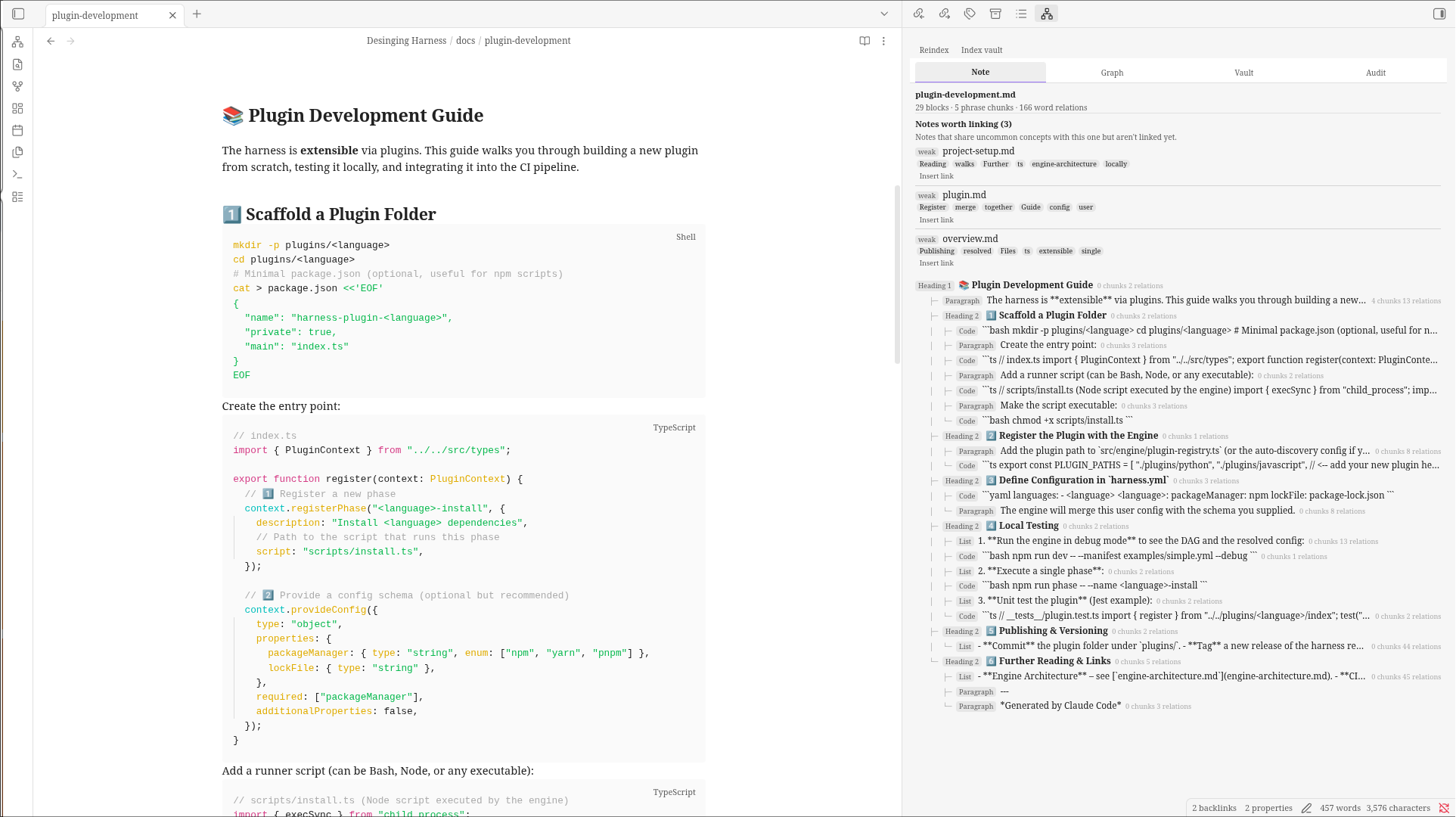
A rule-based (no-LM) pipeline: Markdown / plain text → block tree → canonical concepts → links between notes, with an optional English phrase/dependency parse on top. Shipped as two surfaces that share one Python core and one SQLite store:
- An Obsidian plugin (TypeScript shell + vendored Python backend) — index a vault, read a note’s structure as an outline, see which notes should link to each other, and audit what’s orphaned.
- A Claude Code skill — an agent indexes a path once, then fetches only the blocks it needs (scoped queries, not whole files).
347 tests green, and the 77-file Vault corpus indexes with 0 crashes. Read that as “the contracts hold and nothing falls over” — not as “every layer works well”. Those are different claims, and What the layers are actually worth gives the measured numbers, including the one that is 2%.
Quick links
- What it is & what it’s worth —
docs/OVERVIEW.md← start here - Architecture & implementation —
docs/ARCHITECTURE.md - Usage & installation (Obsidian + Claude) —
docs/USAGE.md - Deployment & distribution —
docs/DEPLOYMENT.md - Obsidian plugin details —
plugin/README.md - Claude Code skill —
.claude/skills/nl-miner/SKILL.md
CLI quickstart (the bridge)
.venv/bin/python -m pytest test/ -q                       # 347 passed
# index a path — --pos builds the concept (token) layer; --parse adds CKY +
# arc-eager. Note: --db goes BEFORE the subcommand.
.venv/bin/python -m interface.cli --db /tmp/g.db index ./vault --pos --json
.venv/bin/python -m interface.cli --db /tmp/g.db search octopus --json      # scoped hits
.venv/bin/python -m interface.cli --db /tmp/g.db view ./octopus.md --parse --json   # per-file parse
# connectivity — what should link to what
.venv/bin/python -m interface.cli --db /tmp/g.db bridge octopus.md         # unlinked notes sharing concepts
.venv/bin/python -m interface.cli --db /tmp/g.db audit                     # orphans + unlinked pairs
.venv/bin/python -m interface.cli --db /tmp/g.db vault --folder 생물         # scoped hierarchical graph
.venv/bin/python -m interface.cli --db /tmp/g.db vault --concept 문어        # notes discussing one concept
Subcommands: index · query · graph · watch · purge · view · search · bridge · audit · vault — each keeps human text by default and emits one JSON object on stdout with --json. (interface/cli.py)
How the vault graph differs from Obsidian’s
Obsidian’s graph is a flat force-directed cloud of every note: position means nothing, the folder tree is discarded, and only links that already exist are drawn. vault gives the three things it can’t:
- 위계 — notes sit under their folders, indented. Layout is computed from document/folder order, not simulated, so nothing drifts between renders.
- 범위 — scope to a folder subtree (
--folder) or to the notes that actually discuss one concept (--concept), instead of the whole vault at once. - suggestions, kept distinct — real wikilinks render solid; bridges (shared concepts, no link yet) render dashed and only for the selected note. A suggestion must never look like a link.
What counts as “related”
Sharing a word is not evidence — it depends entirely on which word. Two notes both saying “use” or “note” are not related; two both saying “hemocyanin” are. So a suggestion is weighted by document frequency (ln(n_files / df)):
- a concept in every note scores 0 and contributes nothing;
- past
MAX_DF_RATIOof the vault it is dropped as vault-wide vocabulary; - pairs rank by summed idf, not overlap size — one rare term beats a dozen ordinary ones;
- code blocks contribute no concepts, and a concept must be a word (not
--json,$DESTorplugin/main).
This is self-calibrating, which a stoplist cannot be: the uninformative words aren’t a fixed list, they’re whatever your vault repeats. On a mixed-topic fixture (biology / cooking / git) this is 100% precision at 84% recall — see OVERVIEW for why that trade is the right way round.
What the layers are actually worth
Measured, not assumed — the numbers decide where the value is:
| layer | reality |
|---|---|
| blocks | works, language-independent; the whole UI renders off this alone |
tokens (--pos) |
works; 21–48% canonical dedup, and it powers bridge/audit/top_concepts |
CKY phrases (--parse) |
~2% coverage on real prose (6/298 sentences across docs/); EN-only |
dep relations (--parse) |
works on EN; skipped on non-EN (skipped_lang) rather than fabricated |
Two metrics look like headline wins but measure something that cannot fire on a real corpus, and are kept only for contract stability — prefer the ones beside them:
saved_tokens/ratiocount byte-identical duplicate blocks → always 0 on real prose. Usetoken_saved/ratio_token.top_canonicalranks those same duplicate-block groups → always empty. Usetop_concepts.parsed_sentencesis satisfied by the dependency parser alone, so it reads ~100% while CKY finds nothing. Usecky_trees/cky_coverage.
Korean
Works on a default install, no NLM_MORPH needed. AutoAdapter routes by script; src/adapters_ko.py strips 조사 so 문어는/문어가/문어를 collapse onto one (문어, NN) node — without which cross-note concept linking cannot fire on a Korean vault at all. The EN-only parsers are gated off per sentence, so Korean yields blocks + concepts but no (fabricated) grammar. 어미 are out of scope: real verb morphology needs an opt-in KoNLPy/MeCab adapter.
Layout
src/            verified core: preprocess, markdown_blocker, linker, cky,
                postagger, adapters_ko, transition_parser, store, context,
                schema, filestructure
interface/cli.py   the 10-subcommand bridge (JSON over stdout)
observer/       stat-poll watcher (stdlib, no watchdog pkg)
payload.py      JSONL serialization
grammar.cfg     EN NF2 CFG (CKY)
test/           27 test files, 347 passed
plugin/         Obsidian plugin (TS shell + vendored backend/)  →  main.js
.claude/skills/nl-miner/   the Claude Code skill (SKILL.md)
docs/           OVERVIEW / ARCHITECTURE / USAGE / DEPLOYMENT
Requirements
- Python ≥ 3.10 (the models use
str | None) with pydantic 2 — the only external dependency (pip install -r requirements.txtinstallspydantic>=2,<3). A preflight names either problem in one sentence if the environment is wrong, rather than failing deep inside pydantic. Korean works out of the box (src/adapters_ko.py, zero deps); the heavier analyzers (spaCy/KoNLPy/MeCab/jieba) are opt-in viaNLM_MORPH, never default. - (plugin build) Node.js only — no bundled runtime deps, no native deps.