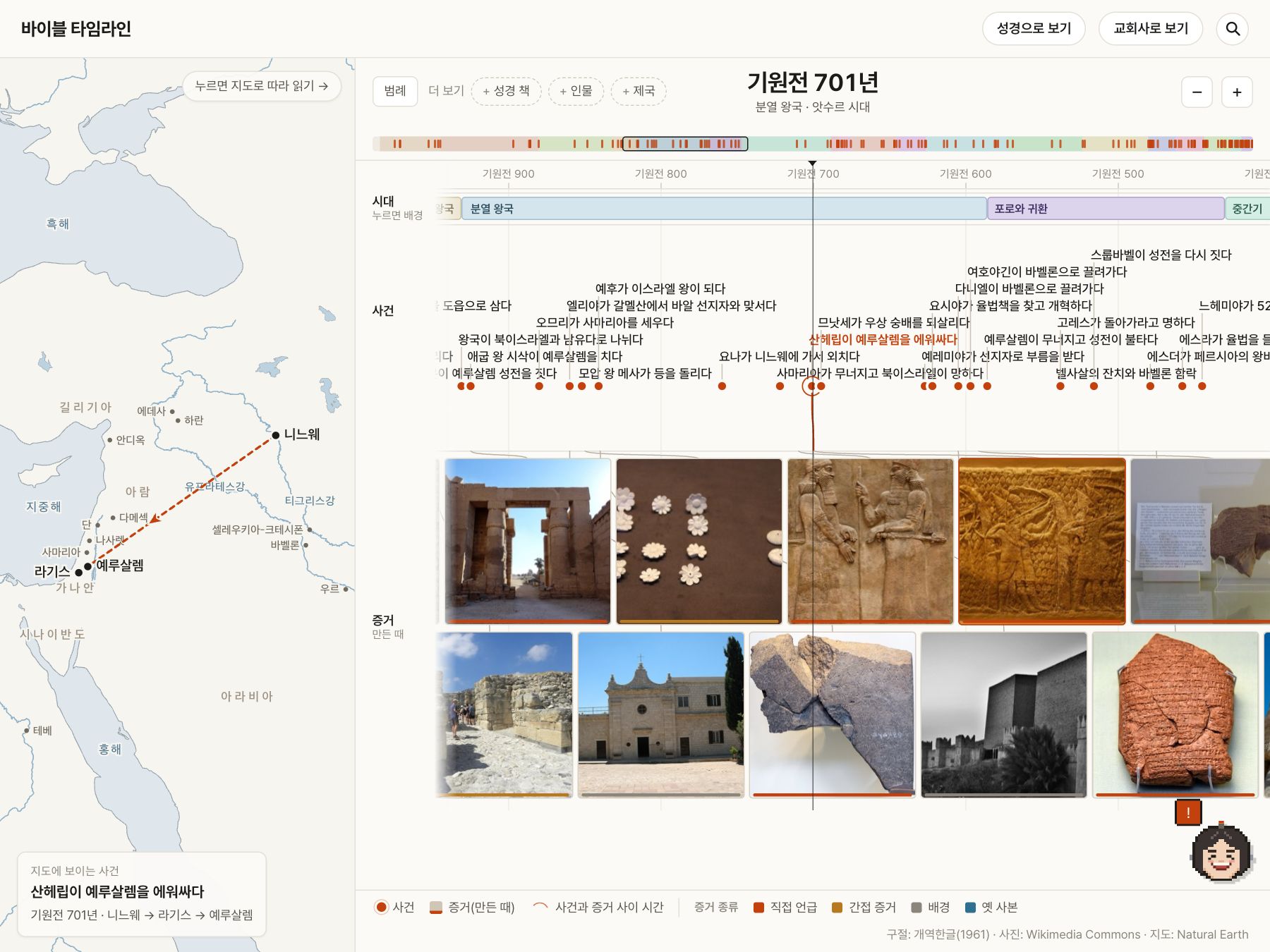
바이블 타임라인 (“Bible Timeline”) puts the events of the Bible on one timeline you slide sideways, from Abraham leaving Haran (around 2091 BC) to the church today. Each event comes with its verse, its place on the map, and photos of real artifacts, each set at the year it was made. It covers 60 biblical events and 92 events from church history, including the church in Korea, plus 158 people with a profile each.
It is live at hong-iron.github.io/BIBLE-TIMELINE. The screenshot at the top is the timeline around 701 BC, when Sennacherib’s army marched on Jerusalem.
My role
A solo project: the research, the information design, the data and the writing, and the front end.
What I built
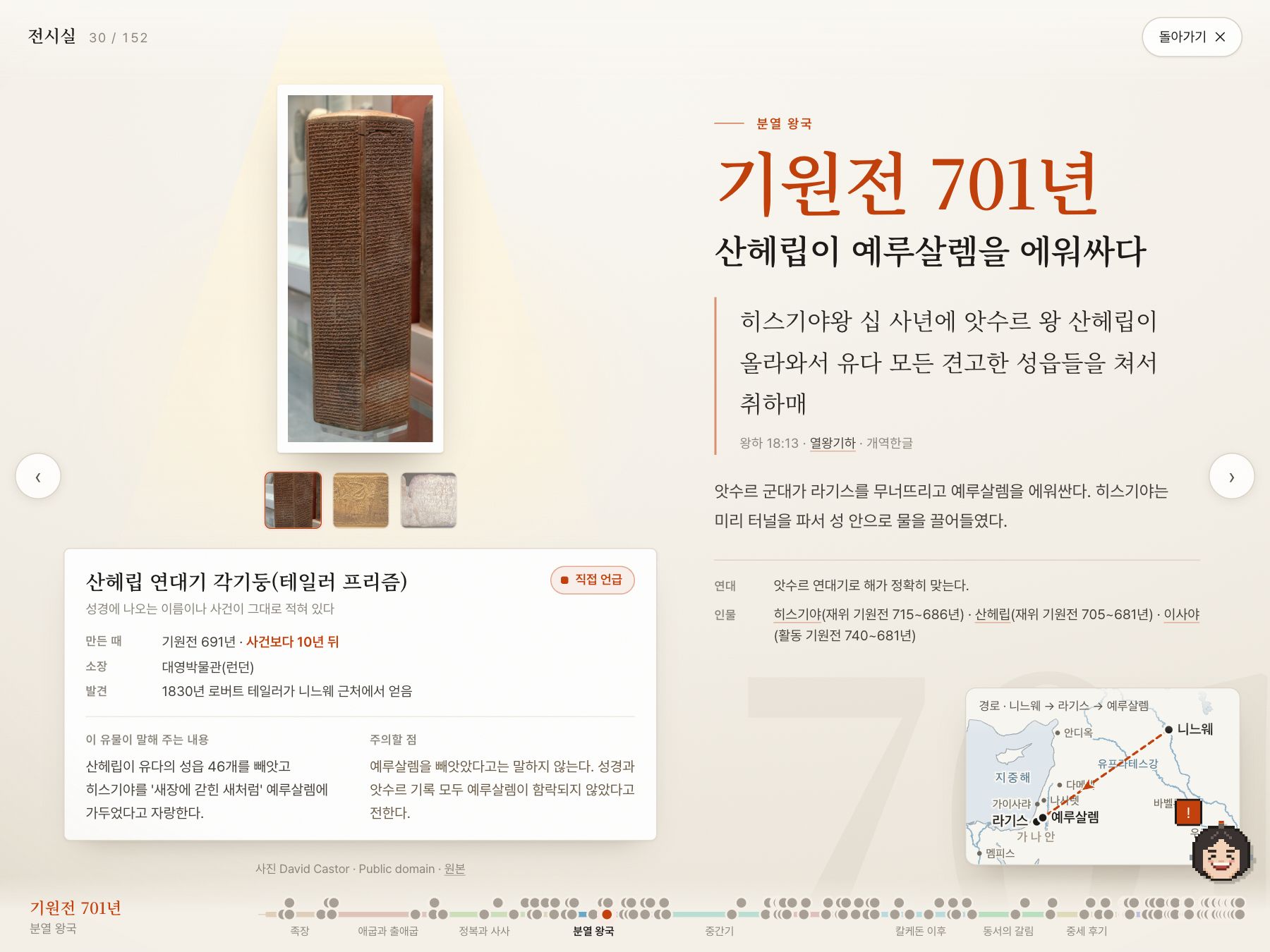
A map beside a timeline. The screen is split in two. On the left, a map follows whatever event sits in the middle of the timeline and draws its route. On the right, the timeline has lanes for eras, events and evidence, and more lanes for the books of the Bible, people and empires can be switched on. Tap an event and its exhibit room opens; slide the rooms and the timeline behind them moves to the same event.
Evidence that says how strong it is. Every artifact carries one of four labels: it names the event directly, it is indirect evidence, it is background, or it is an old manuscript. It also says when it was made relative to the event and what it does not show. The Taylor Prism, for example, names Sennacherib and Hezekiah but never claims that Jerusalem fell. The photos come from Wikimedia Commons, and each one shows its author and licence.
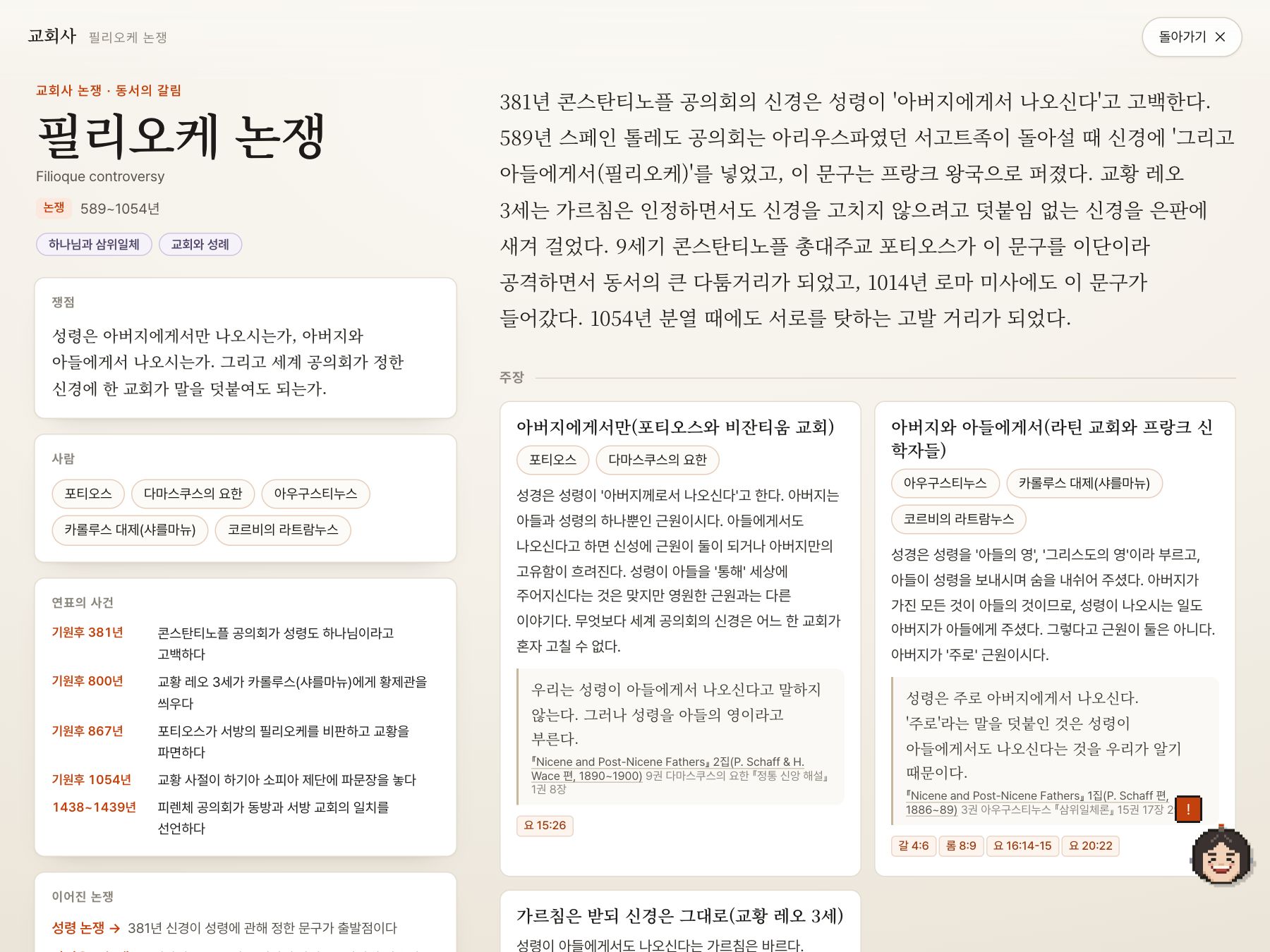
Church history without picking a side. 48 controversies, from Gnosticism to recent debates, are laid out the same way: the question at stake, each side’s argument and its Bible verses, what the councils decided, and where today’s churches stand. The positions are given for six traditions (the Church of the East, the Oriental Orthodox, the Eastern Orthodox, the Catholic Church, Protestant churches by denomination, and academic historians), each under the name it uses for itself. The site does not choose a winner.
More ways in. The 66 books each have a guide and a page on their historical background (events, culture, literature and the way texts were built) with a source for every item. A reading mode lets you scroll through a book’s events while the map follows. One search box finds events, people, books and controversies. A pixel guide named 홍철 answers the questions a visitor is likely to have at the spot they are viewing: 1,344 questions with 4,207 branching answers, prepared ahead of time in the site owner’s voice, so nothing is sent to an AI while you read.
Checks on the data. The Bible text is the 1961 Korean Revised Version, which is out of copyright. Scripts pull every cited verse into the site and compare it against the claim it supports, and other scripts check that every person has a profile, every place named in a book guide is on the map, and every background item has a source.
Fast on phones. At first the map re-projected the whole coastline on every frame, which took about 70% of a phone’s time. Now it draws the map once and moves it with a transform. The heavy data (about 3 MB of verses and profiles) loads only when a screen needs it, and the address bar always holds the current screen, so the back button returns to exactly where you were.
Result
The site is live with 152 events, 158 people, the 66 books and 48 controversies, and every artifact photo credited to its source.
Focus: information design · maps and timelines · source checking · performance